
Key points
- For a sale over $100, Pennsylvania law has the yard copy your driver's license, note your plate and have you sign.
- Unused or undamaged copper pipe and wire, burned wire, marked utility metal and loose catalytic converters are business-only.
- If police report metal stolen, a yard must hold it for up to 48 hours unless a judge extends it.
In this guide
Under Pennsylvania's Scrap Material Theft Prevention Act, a scrap yard must copy your driver's license, note your plate and get your signature for any sale over $100. Some metal, like new copper pipe or burned wire, can only be sold by a business.
The law behind this is the Scrap Material Theft Prevention Act. Here's what it asks of you, what it asks of the yard, and a few related rules worth knowing before you load up.
The law that covers scrap sales in Pennsylvania
Pennsylvania passed the Scrap Material Theft Prevention Act as Act 113 of 2008. Lawmakers made it stricter with Act 79 of 2014. That update added railroad parts to the business-only list and made every yard register with the State Police.
The law puts most of the work on the yard. The yard collects your details, keeps the records and answers to police. Your part is to bring the right ID, sign, and sell only metal that's yours.
The law calls you a "seller" when you sell for yourself, not through a business account. Most homeowners and handymen sell this way.
Lawmakers have proposed changes since 2014. One bill, SB 914, passed the state Senate in 2025 and would move these rules into the crimes code. As of November 2026, none has become law. Some web pages describe old bills as if they were law, so check the date on anything you read.
What the yard writes down when you sell
Under Pennsylvania's Scrap Material Theft Prevention Act, for any sale over $100, the yard must collect all of this:
A photocopy of your driver's license
Your signature and the buyer's signature
The plate number of the vehicle you drove in
Written permission from a parent or legal guardian if you're under 18
The date and time of the sale
What you sold, its weight and how much you were paid
The same list applies to every sale of business-only metal, whatever it's worth. (More on business-only metal below.)
Bring your license every time. State law sets the line at $100, and you won't know whether the sale tops it until your metal is weighed. A yard may also ask for ID on smaller sales. That's the yard's own choice, and the law doesn't stop it.
If you're paid in cash
When a yard pays cash, it must have you sign a receipt. That receipt states that you own the metal or are allowed to sell it. Only sign it if that's true.
If you're under 18
You need a written OK from a parent or legal guardian for any sale over $100. Bring the signed note with you.
Metal only a business can sell
Pennsylvania lets a yard buy some scrap only from a business. A business can be a one-person company or an LLC. You on your own can't sell:
New scrap from a factory, sold by a worker instead of the company
Full-size new materials, like building supplies, and contractors' tools and equipment
Metal marked with a utility, railroad or company name
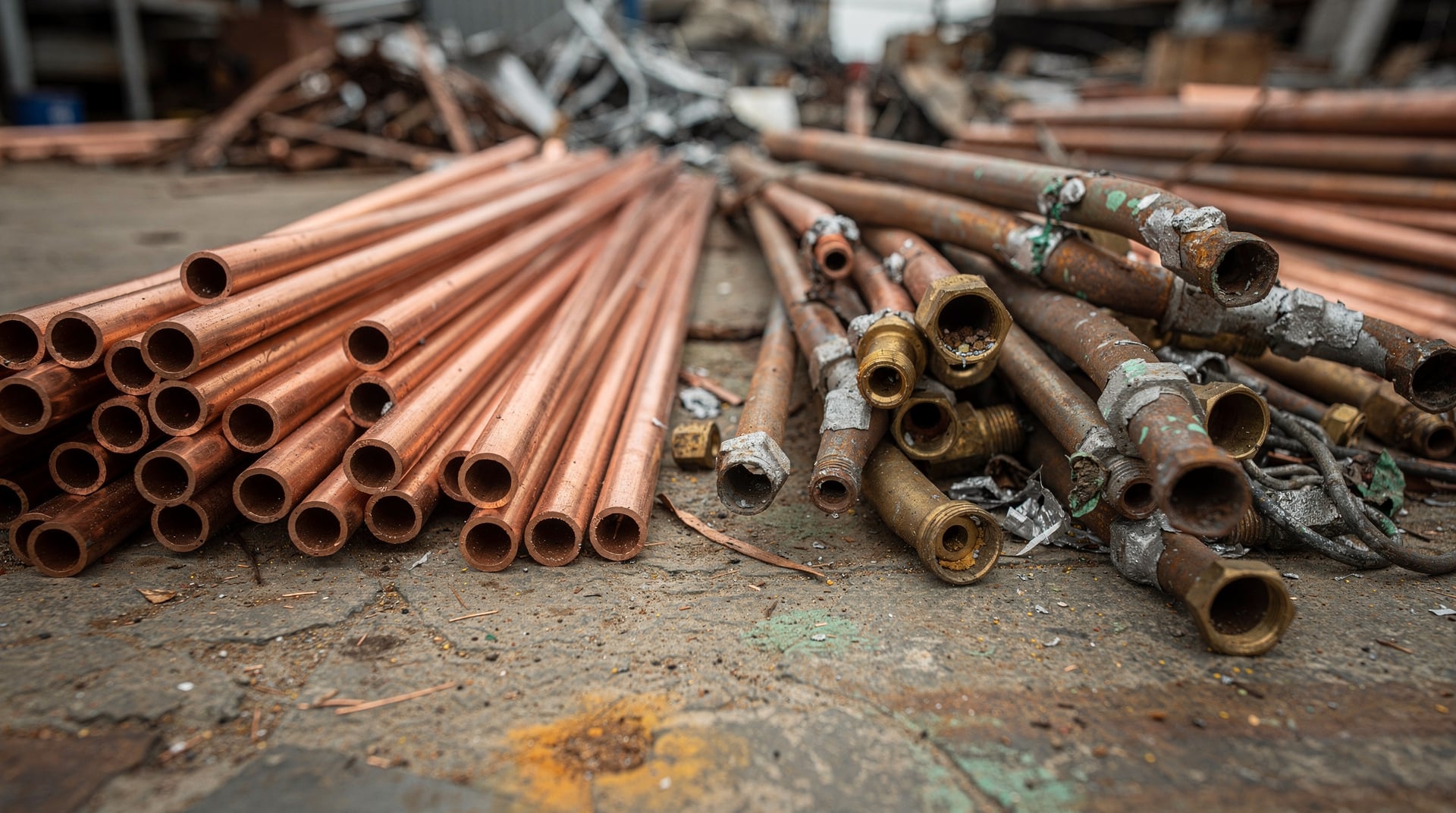
Copper pipe, tubing or wire, and aluminum wire, siding, downspouts or gutters, if unused or undamaged
Manhole and water meter covers, street signs, traffic lights, light poles and guardrails
Grave markers, funeral vases, historical markers and statue plaques
Aluminum or stainless steel fence panels, aluminum decking, bleachers, and farm irrigation wheels, sprinkler heads and pipes
Wire burned to get the plastic off, unless the whole lot is worth less than $100
Beer kegs, loose catalytic converters and railroad parts
This list matters most to the trades. Leftover new copper pipe or a spool of new wire from a job is business-only metal. Sell it through your company, not as yourself.

Old pipe and wire pulled out in a remodel are a gray area. The law lists copper pipe, tubing and wire that's "unused or undamaged," so pipe in good shape may count even if it was used. If you're not sure, ask the yard before you load up.
Don't burn wire. Bring it with the plastic still on. Insulated wire is one of the grades we buy, and the full list is on What We Purchase.
Selling for a company
A business sets up a "commercial account" with the yard. The yard records the business's full name, its federal or state tax ID number, its address and its phone number.
When you drop off metal for that business and get paid, the yard also needs:
A copy of your driver's license
The plate of the vehicle hauling the metal
The business's phone number
A letter signed by the owner or an officer naming you as the person who can be paid
Your signature showing you got the cash, if you're paid in cash
Electricians, plumbers and HVAC techs who sell for a shop should keep that letter in the truck.
When police think scrap is stolen
If an officer tells a yard that some metal was reported stolen, the yard must set matching metal aside. It must tag it and can't cut it, mix it or sell it. The yard then has 24 hours to tell the officer the metal is there. The clock starts at the officer's notice or when the metal comes in, whichever is later.
A police hold can last up to 48 hours. Only a district judge can stretch it longer, and only after finding probable cause that the metal is lost or stolen. Once the hold ends, the metal goes back to its owner or is released.

The yard keeps each sale's records for at least two years. Police investigating a crime can ask to see them during business hours.
The penalties for stealing metal
Taking copper or other metal for scrap is a crime of its own in Pennsylvania, called theft of secondary metal. It grows more serious as the value climbs. At $1,000 or more it's a felony, and a third or later offense is a felony no matter the value.
If someone is convicted of stealing scrap or receiving stolen scrap, the scrap law lets a court impound the vehicle used to steal or haul it. For a first offense, that's 30 to 60 days. Pennsylvania also made stealing a catalytic converter its own crime in 2022.
How to check a yard is registered
Every scrap yard in Pennsylvania must register with the State Police. It renews every two years, and each location registers on its own. The yard must post its notice of registration where you can see it. Its ads in the state must show its registration number.
The State Police keep a list of registered scrap yards that you can search by name or county. A yard that doesn't register faces a $1,000 fine.
Before you load up
Put your driver's license in your pocket.
Note the plate of the car or truck you're driving.
Leave unused or undamaged pipe and wire, and burned wire, at home unless a business is selling it.
Leave anything marked with a utility, railroad or company name at home.
If you're under 18, bring a signed note from a parent or guardian.
If you sell for a company, bring the owner's signed letter.
Keep wire in its plastic and sort your metal by grade.
Have a question about an item or the paperwork? Call our Harrisburg yard at (717) 562-7022, or come by 916 S 18th St, Harrisburg, PA 17104. We're open Monday to Friday, 9 AM to 6 PM, and Saturday, 9 AM to 3 PM. More about the yard is on our Harrisburg yard page.
Questions
Is it legal to pick up scrap metal from the side of the road?
No state law in Pennsylvania deals with curb picking directly, a State Police spokesman told WITF in 2024. But some towns ban it, including the city of Lancaster, with fines of up to $1,000. Taking anything from private property can also be theft or trespass, so ask the owner first and check your town's rules.
Do you have to pay taxes if you scrap metal?
Often, yes: the IRS says income is taxable unless the law exempts it. If scrapping is part of a business you run, self-employment tax usually applies once your net earnings reach $400. If you sell your own household junk for less than you paid, that loss on personal-use property isn't deductible. Your case depends on the details, so ask a tax professional.