
Key points
- Insulated wire sells as is, graded by how much copper is inside.
- Strip thick wire only when the gain beats your time. Sell thin wire as is.
- Never burn the jacket off. It lowers the grade, and Pennsylvania and Texas rules restrict it.
In this guide
Yes, copper wire is worth recycling, and it's worth money even with the jacket still on. Stripping it pays only when the copper you gain is worth more than your time, which is more likely with thick wire than thin wire.
At our Harrisburg yard, insulated wire was the biggest single grade by weight from late June to late September 2026.
How insulated wire is graded
Bare copper wire is graded by how clean it is. The scrap trade group ReMA publishes the industry's grade rules. In its scrap specifications, the top wire grade is bare bright: bare, uncoated, unalloyed copper wire.
Insulated wire works differently. ReMA's insulated wire grades (code names Druid and Droid) are sold on a sample or recovery basis. The buyer and seller agree on how much copper is in it, often from a sample. The industry sets no fixed number.
Recovery means how much copper is inside the wire by weight. Wire that is mostly copper has high recovery. Wire that is mostly plastic has low recovery. That is why one pound of insulated wire can be worth much more than another.
Our wire grades
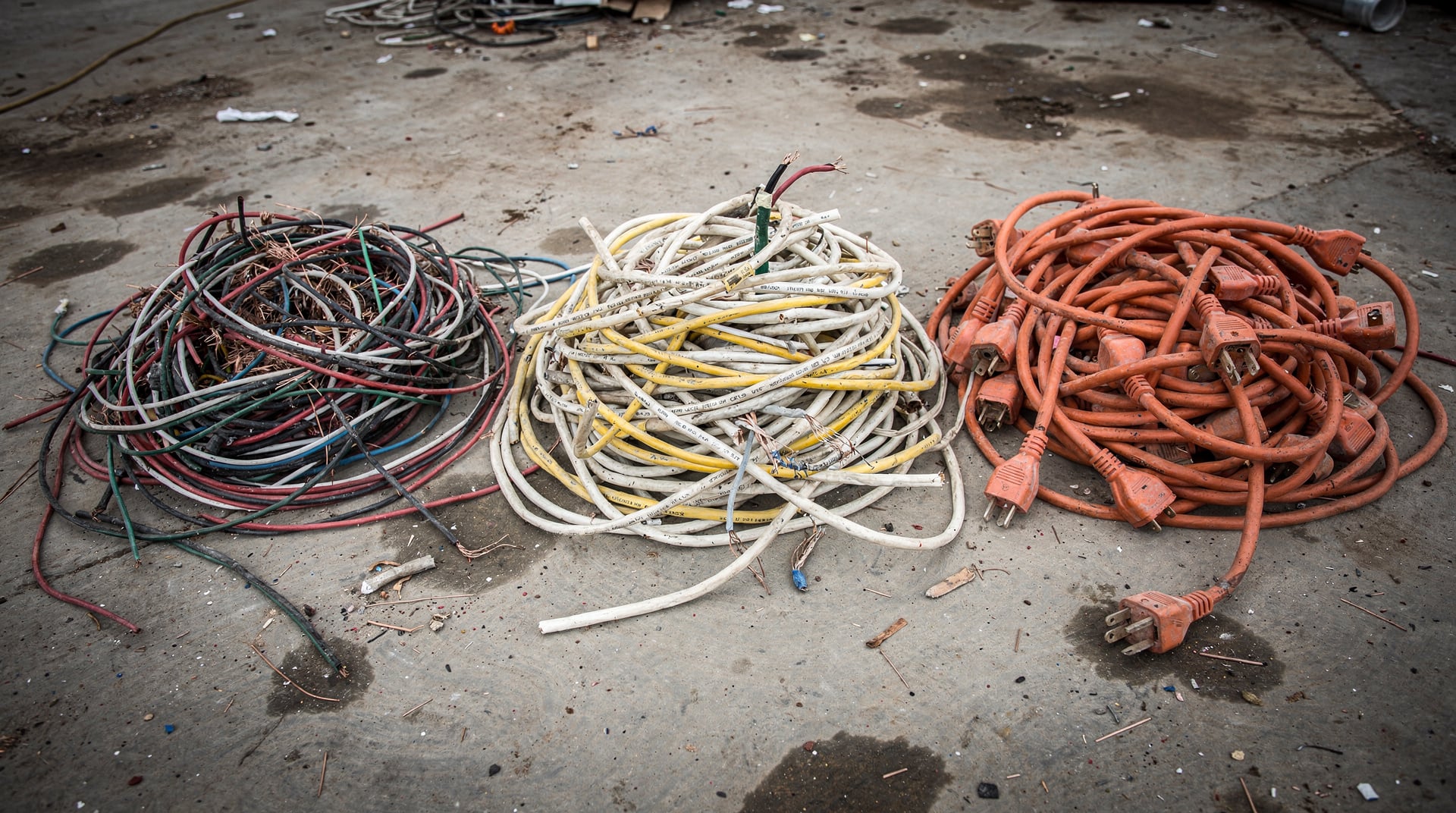
Our list of what we buy has eleven lines for wire. Keep each kind in its own bucket.
Insulated Copper Wire (Cat 5/6)
This is network cable. Cat 5e and Cat 6 cable from Belden has four twisted pairs of thin solid copper wire. AWG is wire gauge, and a bigger number means a thinner wire. These are 24 AWG or 23 AWG, much thinner than house wire.
Watch for cheap cable made of aluminum with a thin copper coat. It's called copper-clad aluminum, and a 2011 industry alert says it breaks several cable standards. Keep it apart and ask us.
Insulated Wire and Insulated Cable
These are two separate lines on our list. Not sure which one your wire fits? Keep it apart and ask us at the counter. We'll tell you where it goes.
Romex Wire
Romex is Southwire's brand of NM-B cable. Per Southwire's spec, it has insulated copper wires, a bare copper ground with a paper wrap, and a PVC jacket over it all.
THHN Cable
THHN is a single copper wire with plastic insulation and a nylon outer layer. Cerrowire calls it a 600 volt building wire.
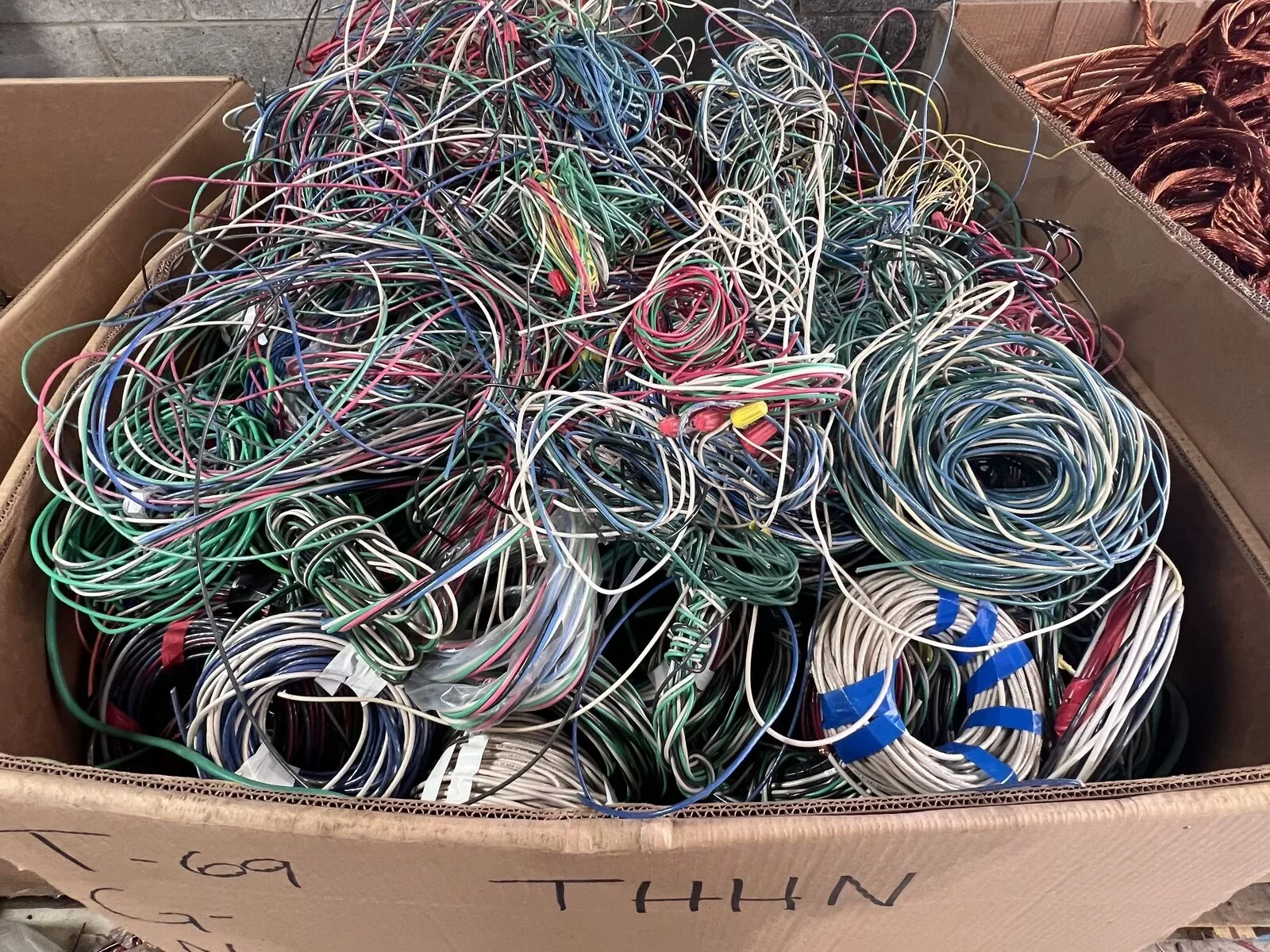
Fire Wire and Computer Wire
Each of these has its own line on our list. Keep each one in its own bucket, and ask us at the counter before you mix anything in.
500 to 750 MCM
MCM means one thousand circular mils, a measure of wire size. Per the Windy City Wire glossary, 500 MCM equals 500,000 circular mils. This is big feeder cable.
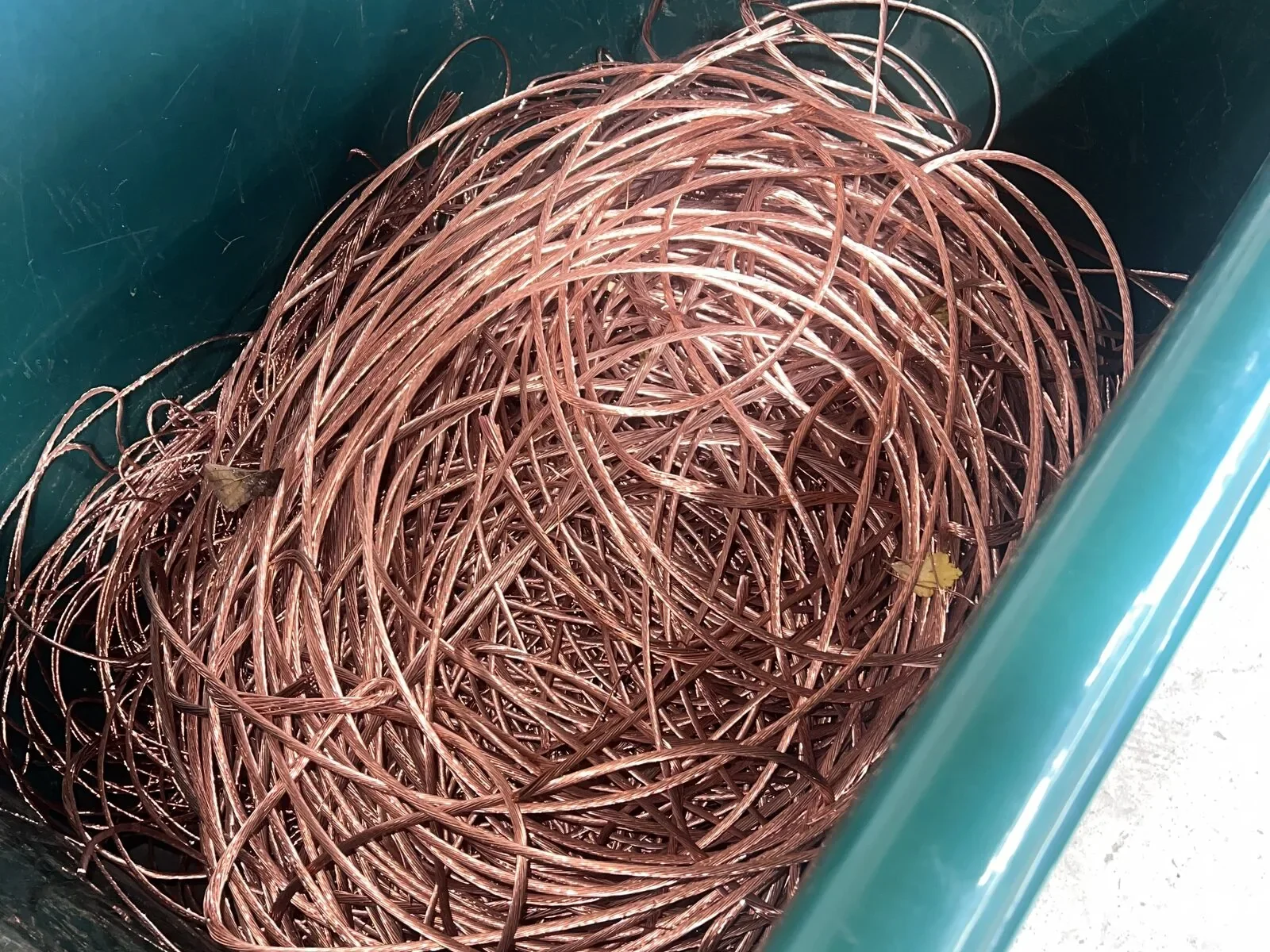
#1 Bare Bright Wire
This is clean, bare copper wire with no coating and no alloy, as ReMA's specs put it. Tinned or painted wire has a coating, so it doesn't make the grade. Our guide to #1 vs #2 copper shows how to tell them apart.
Why some wire has more copper
Thick wire carries more copper for each pound of plastic. Southwire's own numbers show it.
12/2 Romex: about two-thirds copper by weight. Per Southwire's spec, 1,000 feet weighs about 86 pounds, and about 59 pounds of that is copper.
500 MCM THHN: more than 90% copper. Per Southwire's spec, 1,000 feet weighs about 1,662 pounds, with about 1,543 pounds of copper.
Thin data cable and small cords have much less copper per foot. A full 1,000-foot box of Belden's Cat 5e cable weighs about 18 pounds, jacket and all.

More copper inside means the wire is worth more per pound. It also means stripping goes faster for each pound of copper you get.
When stripping pays
Here is the test. Work out how much more the copper is worth bare. Then divide that by the hours it takes you. If the hourly number is worth your time, strip it. If not, sell it as is.
The price ratios in the examples below are made up to show the math. They are not our prices. Call us for today's prices before you run the numbers.
Thick wire: can be worth it
Made-up example: You have 50 pounds of 12/2 Romex. About 59 of every 86 pounds is copper, so that's about 34 pounds of copper. Say bare bright pays 2.7 times the Romex price. Then your 34 pounds of stripped copper are worth as much as about 92 pounds of Romex, not 50. Stripping gains you about 84%. Weigh that gain, less the cost of a blade or tool, against the 3 hours stripping by hand might take.
Again, those numbers are made up to show the math. Your own result depends on real prices and how fast you work. The smaller the gap between the insulated price and the bare price, the less stripping pays.
Made-up example: Same 50 pounds of Romex, but now bare bright pays only 1.8 times the Romex price. Your 34 pounds of stripped copper are worth as much as about 61 pounds of Romex. Stripping gains you only about 22%, for the same 3 hours of work.
That's the same wire and the same work, with a smaller price gap. Always check both prices before you start. A stripping tool helps a lot with heavy wire.
Thin wire: usually not
Thin wire flips the math. Cat cable, lamp cords and phone wire hold little copper per foot. A box of thin cable takes a long time to strip and gives you little copper. ReMA's top insulated grade even leaves out wire thinner than 16 gauge, unless the buyer and seller agree. Cat cable, at 23 or 24 gauge, is thinner than that. For thin wire, sell it as is.
Stripped wire must be clean
Stripped wire only counts as bare bright if it is clean, bright and uncoated. Bits of insulation left on, or tinned wire, will drop it down a grade. Then you've done the work and lost much of the gain.
Safety first
Never strip wire that may still be connected to power. A NIOSH toolbox talk tells of a worker who was killed while stripping house wire on a live 110 volt circuit. Shut off the power first. Then test the wire with a voltage tester to be sure it's off.
When you strip, keep the blade pointed away from your body. Wear gloves.
Never burn the jacket off
Burning wire is restricted in Pennsylvania and Texas. It also costs you money.
Texas: state air rules say electrical insulation must not be burned.
Pennsylvania: state rules ban open burning in air basins. The Harrisburg air basin includes the City of Harrisburg.
The grades: ReMA's specs say #1 copper wire must be free of brittle, burned wire, and #2 should be free of wire from burning.
Burned wire also draws extra rules at the scale. In Pennsylvania, a yard can buy burned wire only from a business, unless the whole lot is worth under $100. Texas law lists wire that has been burned to remove the insulation as regulated metal.
Bringing your wire in
The best way to recycle copper wire: sort it by grade, leave thin wire in its jacket, strip thick wire only if the math works, and never burn it. Sorting keeps good wire out of a lower grade.
Use one bucket for each grade on our list.
Keep aluminum wire out of every copper bucket.
Keep any wire you're unsure of in its own bucket.
Ask us whether to cut off plugs and ends before you do the work.
Call or visit our Harrisburg yard at 916 S 18th St, (717) 562-7022. It's open Monday to Friday, 9 AM to 6 PM, and Saturday, 9 AM to 3 PM. Or call our Corpus Christi yard at 3717 Saturn Rd, (361) 462-4387. Call first for its hours.
Questions
How to get rid of copper wire?
Sell it to a scrap yard instead of throwing it out. Old wire still has copper in it, and copper is worth money. Coil or bundle it so it's easy to handle and weigh.
What can I do with old copper wire?
If it's in good shape and you have a use for it, keep it for your next project. If not, don't let it sit in the garage. Coil it, sort it by kind, and sell it by the pound, jacket and all if you don't want to strip it.